
The 80/20 Battery Rule Explained: What It Really Means for Different Battery Types

The 20-80 battery rule is about avoiding full charges and deep discharges to extend battery life, mainly for lithium-ion batteries.
You’ve probably heard the advice: “Keep your phone battery between 20% and 80%.” But does this rule apply to all batteries? And what does it actually mean for your power station, solar setup, or backup battery?
Let’s break it down - no chemistry degree required.
What Is the 80/20 Rule?
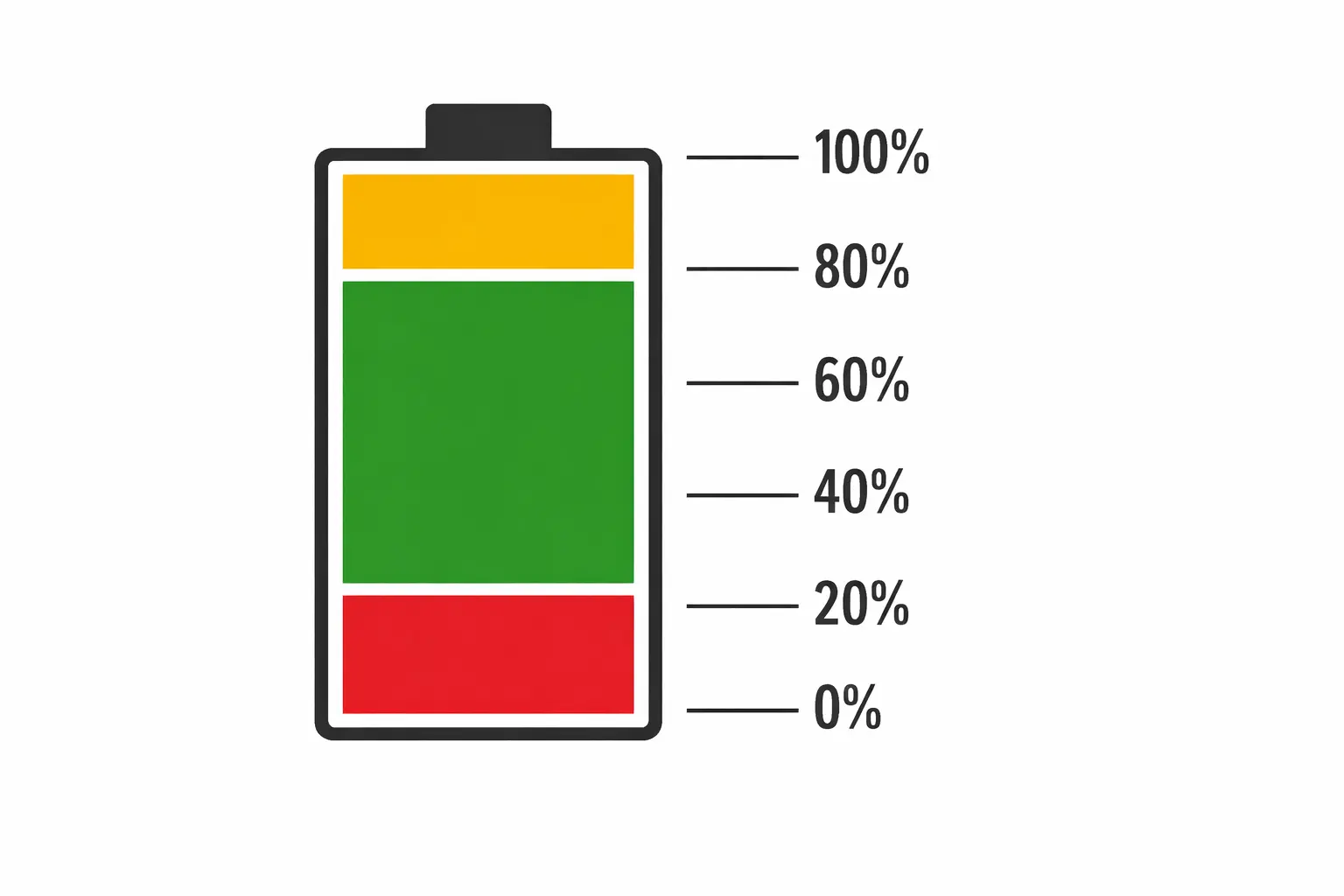
The 80/20 rule is simple: don’t charge your battery above 80%, and don’t let it drop below 20%. This keeps your battery in the “sweet spot” where it experiences the least stress.
Why? At very high and very low charge levels, battery cells age faster. Staying in the middle range slows that aging and can significantly extend battery lifespan.
This rule became popular with smartphones, but it actually applies (with some modifications) to most lithium-based batteries.
The Science Behind It: Depth of Discharge (DoD)
To understand why the 80/20 rule works, you need to know about Depth of Discharge (DoD).
DoD measures how much of a battery’s capacity you actually use. If you have a 100Ah battery and use 50Ah before recharging, your DoD is 50%.
The deeper you discharge a battery, the fewer cycles it will last. The 80/20 rule limits your DoD to 60% (from 20% to 80%), which significantly extends battery life.
| DoD | Typical Cycle Life (Lithium-ion) |
|---|---|
| 100% (full discharge) | ~500 cycles |
| 80% | ~900 cycles |
| 50% | ~1,500 cycles |
| 20% | ~3,000+ cycles |
Different Batteries, Different Rules
Here’s where it gets interesting. The 80/20 rule was designed for standard lithium-ion batteries. But not all batteries are created equal.
LiFePO4 (Lithium Iron Phosphate)
Best for solar & power stationsMax DoD: 80-90% · 2,000-5,000 cycles
The standard for solar systems and portable power stations. The chemistry is inherently more stable, so you can safely discharge to 80-90% DoD without dramatically shortening lifespan. Charging to 100% is safe for regular use. The 80/20 rule is overly conservative here — but still makes sense for long-term storage.
Standard Lithium-ion (Li-ion)
Phones, laptopsMax DoD: 60-80% · 500-1,000 cycles
This is what’s in your phone, laptop, and many portable devices — and where the 20-80% guideline is most useful. Stick to 60-80% DoD for maximum longevity. Full charges occasionally won’t kill the battery, but making it a daily habit will shorten its life.
AGM (Absorbent Glass Mat)
Backup power, marineMax DoD: 50% · 300-500 cycles
Common in RVs, boats, and backup power systems. These batteries really suffer from deep discharges — going below 50% regularly will significantly shorten their lifespan. Forget the 80/20 rule here. The 50% rule is what matters.
Lead-Acid (Flooded)
Cars, budget solarMax DoD: 30-50% · 200-300 cycles
The old-school batteries you find in cars and budget solar setups. Even more sensitive than AGM — deep discharges cause sulfation, which permanently reduces capacity. Keep them topped up whenever possible, and definitely don’t let them sit at low charge.
FAQ
Does the 80/20 rule really work?
Yes, for lithium-ion batteries. Studies consistently show that limiting charge to 80% and avoiding deep discharges extends cycle life significantly. However, modern battery management systems have made full charges safer than before.
Is it bad to let my battery go below 20%?
For lithium-ion, occasionally going lower is fine. For AGM and lead-acid, try to avoid going below 50%. For LiFePO4, you can safely go down to 10-20%.
Should I charge my LiFePO4 battery to 100%?
Yes. LiFePO4 batteries don’t have the same stress at high charge levels as lithium-ion. Charging to 100% is generally safe for LiFePO4 batteries and is often recommended occasionally for calibration. For more details, see our LiFePO4 charging guide.
What’s the best percentage to store a battery?
Around 40-60% for lithium batteries, 100% for lead-acid and AGM. Never store any battery at 0%.
So, Should You Follow the 80/20 Rule?
The 80/20 rule is a useful guideline, not a universal law. What really matters is understanding your battery type:
- LiFePO4: Use 80-90% of the capacity without worry.
- Lithium-ion: The 80/20 rule helps, but don’t stress about occasional full charges.
- AGM/Lead-Acid: The 50% rule is your priority. Never deep discharge these.
Match your charging habits to your battery chemistry, and you’ll get the most life out of your investment.
Not sure what battery type you have? Check the label - it usually says LiFePO4, Li-ion, AGM, or Lead-Acid right on the case.
Need to calculate how long your battery will actually last? Check out our Battery Runtime Calculator — it factors in DoD for accurate runtime estimates.