
Na-ion in real life: lifespan, cold weather, and cost reality
- Lifespan depends more on how you use it than the chemistry label
- Cold weather is where Na-ion really shines - and where Li-ion needs heaters
- Cost per kWh is often quoted misleadingly - compare usable Wh plus warranty
Lifespan
“How long does it last?” has three different answers:
| Metric | Na-ion | LiFePO4 | NMC Li-ion |
|---|---|---|---|
| Calendar life | 10–15 years | 10–15 years | 5–10 years |
| Cycle life | 4,000–6,000 | 4,000–8,000 | 1,000–3,000 |
| Typical warranty | 5–10 years | 10 years | 5–8 years |
Cycle life = cycles to 80% original capacity. Na-ion and LFP are comparable; NMC degrades faster.
Heat is the biggest enemy - storing or running above 40°C accelerates degradation. Deep cycling (0–100%) ages cells faster than staying in the 20–80% range. Keeping a full charge for weeks hurts some chemistries, and constant fast charging adds stress too.
Manufacturers rate cycle life to 80% capacity retention. When your 1,000 Wh pack drops to 800 Wh, that’s “end of rated life” - but it’s still perfectly usable. If runtime was 10 hours new, expect ~8 hours after rated cycle life.
Cold weather
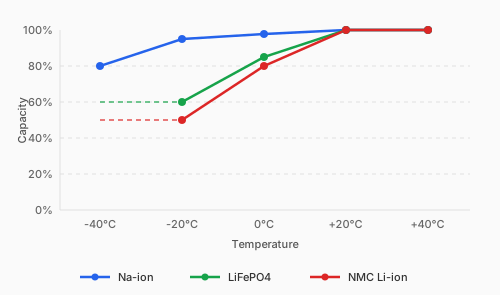
At -20°C, Na-ion retains ~90% capacity while LFP drops to 60-70%. CATL claims their Na-ion cells keep 90%+ capacity even at -40°C - at that temperature, lithium batteries are basically paperweights.
Discharging in cold is one thing. Charging is another. Most Li-ion packs can’t charge below 0°C without damage (lithium plating risk). Na-ion typically handles charging down to -20°C or colder. That’s a huge practical difference - you can recharge Na-ion in an unheated garage or outdoors in winter.
| Chemistry | Min discharge temp | Min charge temp |
|---|---|---|
| Na-ion | -20°C to -40°C | -20°C to -30°C |
| LiFePO4 | -20°C | 0°C (needs heater below) |
| NMC | -20°C | 0°C (needs heater below) |
Before buying, check both the discharge temp range (covers your coldest conditions?) and the charge temp range (can you recharge without heating?). Some packs include built-in heaters. Also worth knowing: does the BMS shut down completely in cold, or just limit power?
Cost
Na-ion dropped from $80-105/kWh (2022) to ~$59/kWh (2025). LiFePO4 sits at ~$52/kWh. The gap is only ~13% - not the “sodium is way cheaper” story you might have heard. Target: ~$40/kWh at scale (IRENA, IDTechEx). These are cell-level costs; pack-level (BMS + enclosure) adds ~$10-20/kWh.
Why isn’t Na-ion cheaper yet? Scale is the main barrier - only ~10 GWh produced in 2024 vs 2,400+ GWh for Li-ion (market immaturity explains more). The lithium price crash didn’t help either: from $80,000/tonne (2022) to ~$10,000/tonne (2024), making LFP dirt cheap. And without exchange pricing, Na-ion cost estimates vary widely.
Don’t just compare $/kWh - compare cost per usable Wh over the lifetime. That means factoring in usable capacity (rated Wh × DoD limit), round-trip efficiency (~92% for Na-ion, 90-95% for Li-ion), cycle life (more cycles = lower cost per kWh delivered), warranty length, and cold-weather limitations.
A $500 Na-ion pack with 10-year warranty and good cold specs may beat a $400 LiFePO4 pack that needs a $200 heater for winter charging.
FAQ
What is the lifespan of a sodium-ion battery?
10–15 years calendar life, 4,000–6,000 cycles to 80% capacity (comparable to LiFePO4). Real lifespan depends on temperature (avoid heat), depth of discharge (shallower is better), and charge rates (slower is gentler).
How do sodium-ion batteries perform in cold weather?
Better than lithium. Na-ion retains ~90% capacity at -20°C vs ~60% for LiFePO4. More importantly, Na-ion can charge at -20°C while most Li-ion can’t charge below 0°C without heaters.
How much do sodium-ion batteries cost per kWh?
~$59/kWh at cell level (2025, Wood Mackenzie). That’s only 13% more than LiFePO4 ($52/kWh). Add ~$10-20/kWh for pack-level. Target: ~$40/kWh by 2030.
Is Na-ion worth the small premium?
The cost gap is small (~13%). Na-ion makes sense if you need cold-weather operation (below -20°C) or value supply chain independence (no lithium, no cobalt). For moderate climates, LiFePO4 still edges out on value.
How fast does Na-ion degrade?
Similar to LiFePO4. Expect ~2-3% capacity loss per year in typical use. Keeping the pack cool and avoiding constant 100% charge helps longevity.
Last updated: January 2026