How Long Will a Battery Run Your CPAP?
A CPAP without heating draws about 40W - similar to a laptop. Add heated humidification and you’re looking at 60-70W. That difference determines whether a 500Wh battery lasts all night or runs out at 4am.
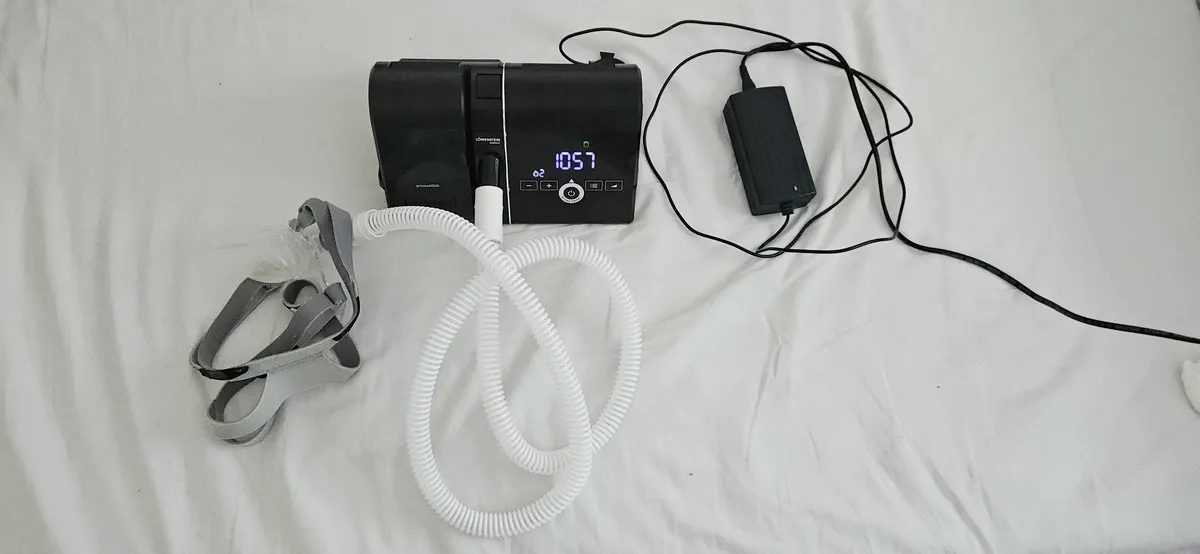
By the end, you’ll know what capacity you actually need — and when a DC cable matters more than a bigger battery. We’ll use the Löwenstein Prisma SMART as our reference device, but the calculations work for any CPAP.
This guide covers batteries and power calculations, not medical therapy. Never adjust prescribed pressure settings without consulting your sleep specialist.
How Much Power Does a CPAP Use?
The Prisma SMART is rated at 40 VA maximum - that’s your upper limit for the therapy unit alone. But “maximum” isn’t “typical.” Your actual draw depends on pressure settings, mask seal, and whether you’re running heated humidification.
Without humidifier: Plan for up to 40W. This covers the blower motor doing its job. Many users see lower averages (25-35W), but 40W is the safe planning number.
With heated humidifier: The Löwenstein prismaAQUA humidifier is rated at up to 30W depending on your heat setting. Combined with the therapy unit, budget for 60-70W total.
Heated tubing increases draw further. Exact numbers vary by model and ambient temperature - check your specific setup or measure it directly.
Quick Runtime Reference
Estimated runtimes for popular power stations at 40W, assuming ~85% usable capacity, 80% AC efficiency, and 90% DC efficiency:
| Power Station | Capacity | Via AC | With DC Adapter |
|---|---|---|---|
| Bluetti EB3A | 268Wh | ~4.5h | ~5h |
| EcoFlow River 2 Max | 512Wh | ~8.5h | ~10h |
| Jackery Explorer 500 | 518Wh | ~9h | ~10h |
| Jackery Explorer 1000 V2 | 1,002Wh | ~17h | ~19h |
| EcoFlow Delta 2 | 1,024Wh | ~17.5h | ~19.5h |
| Bluetti AC180 | 1,152Wh | ~19.5h | ~22h |
Real-world results vary — stations with large inverters may show lower AC runtimes at low loads due to idle draw.
DC adapter tip: The DC adapter (~$60-80) typically adds ~10-25% more runtime by skipping the inverter, sometimes more on stations with high AC idle draw. All these stations have 12V DC output (“car port”) compatible with CPAP DC adapters.
Your Power Options
Dedicated CPAP Batteries
$300-40095-150Wh
Designed for air travel — compact, FAA-compliant under 100Wh. A 95Wh battery gives ~2 hours at 40W. Works for travel CPAPs (10-15W), falls short for full-size machines. The Medistrom Pilot-24 Lite (95Wh) is a popular option.
Mid-Size Power Stations
$200-500256-500Wh
The practical choice for no-heat users. A 500Wh station runs a 40W CPAP for ~10 hours via DC. With humidifier at 65W, expect ~6 hours. In this range, the brand matters less than usable Wh and whether you can run DC.
Large Power Stations
$400-900600-1000Wh
The safe bet for heated humidification. 600Wh delivers ~7 hours at 65W via DC. Larger units give you margin for cold nights or multiple nights without recharging. Worth the extra weight for off-grid reliability.
DC vs AC: Why Connection Type Matters
Most power stations offer both AC outlets and 12V DC ports. The AC outlet seems convenient - just plug in your CPAP’s regular power brick. But here’s the problem: your power brick converts AC right back to DC. That double conversion wastes 10-20% of your battery capacity.
Direct DC connection skips the inverter entirely. The Prisma SMART runs on 24V DC, and the optional DC adapter (Löwenstein WM 24469, ~$60-80) lets you power it from 12V or 24V sources without using an inverter. It’s not included with the device and must be purchased separately.
One catch: most power stations only provide 12V DC (“car port”), while many CPAPs - including the Prisma SMART - need 24V. If that’s your situation, you’ll need a 12V-to-24V DC-DC cable designed for your CPAP model. Using the wrong voltage can damage your device. Check your CPAP manual for DC input specs, and get the manufacturer-recommended adapter rather than a generic converter.
Calculate Your Runtime
Select your CPAP setup and battery to see estimated runtime. Try switching between “CPAP” at 40W and “CPAP with Humidifier” at 65W to see how heated humidification affects your battery life. For DC connection, select “CPAP + DC Adapter” variants:
Runtime Calculator
1. What are you powering?
2. Power Source
3. Powering devices
Your battery will last
at 85% efficiency, 90% usable capacity
Maximize Your Battery Life
Disable heated humidification - this is the single biggest power saver. Turning off the heater can cut your power draw nearly in half. Humidification is a comfort feature, not a therapy parameter. Many people travel without it and sleep fine. If you’re unsure whether skipping humidity affects your specific therapy needs, ask your clinician.
Use DC power when possible - direct DC connection gains you 10-15% over running through the inverter. That extra efficiency could mean the difference between making it through the night or not.
Check your mask seal - air leaks force the blower motor to work harder, increasing power draw. A well-fitted mask with minimal leakage runs more efficiently.
Air Travel with CPAP Batteries
Lithium battery rules vary by airline and country. General FAA guidance: batteries under 100Wh are allowed in carry-on luggage without special approval. Batteries between 100-160Wh may require airline approval and have quantity limits. Spare batteries must be carried on (not checked), with terminals protected against short circuits.
Most dedicated CPAP batteries are deliberately designed to stay under 100Wh for exactly this reason.
Before you fly, verify current requirements with your airline and local aviation authority. Rules vary by country and carrier. Some CPAP manufacturers provide “safety in flight” documentation - check your device’s paperwork or the manufacturer’s website.
Camping and Off-Grid
For a single night without humidifier, a 500Wh power station is enough. For a weekend, go 1000Wh+ or bring a solar panel to recharge during the day. Using heated humidification? Budget 700Wh+ per night.
Solar panels pair well with power stations for extended off-grid stays. A 100W panel can replenish 300-400Wh during a sunny day - enough to top up for another night. Just don’t rely on solar as your only backup; cloudy days happen.
Brand Compatibility
The math in this guide works for any CPAP - ResMed, Philips, Fisher & Paykel, or others. The key variable is your device’s actual power consumption and DC voltage requirements.
Before buying any battery or adapter, check two things in your CPAP’s manual: the wattage (or VA) rating, and the DC input voltage (typically 12V or 24V). Using the wrong voltage adapter can damage your device or simply not work.
FAQ
How long will a CPAP battery run?
It depends entirely on battery capacity and your power draw. At 40W (no heated humidification): a 95Wh travel battery lasts ~2 hours, while a 500Wh station lasts ~10 hours via DC. With humidifier at 65W, expect roughly 40% less runtime.
How much battery do I need for 8 hours?
Without humidifier (~40W): around 420Wh via DC, ~470Wh via AC. With heated humidifier (~65W): around 680Wh via DC, ~760Wh via AC. These account for ~85% usable capacity and conversion losses.
Can I run my CPAP without the humidifier?
Yes. Humidification is a comfort feature that prevents dryness, not a core therapy component. Many people travel without it. If you have specific concerns about your therapy, check with your sleep specialist.
How do I power a CPAP while camping?
A portable power station is the standard solution. For no-heat setups, 500Wh covers one night. For a weekend, go 1000Wh+ or bring a solar panel for daytime recharging. With heated humidification, budget 700Wh+ per night.
Can I take a CPAP battery on a plane?
Batteries under 100Wh are generally allowed in carry-on luggage. Larger batteries (100-160Wh) may need airline approval. Always check current FAA guidelines and your airline’s specific policy before traveling.
What size portable power station for CPAP?
Without humidifier: 500Wh covers a full night via DC with some margin. With heated humidification: 700Wh+ for a reliable full night. Larger stations (1000Wh) handle multiple nights or high-draw setups.
Do ResMed and Philips CPAPs work with batteries?
Yes, all major brands work with appropriate batteries. Check your specific model’s wattage and DC voltage requirements (12V or 24V) when selecting power sources and adapters.
Image: Wikimedia Commons (CC0 1.0, author: Mnalis)

Last updated: February 2026